







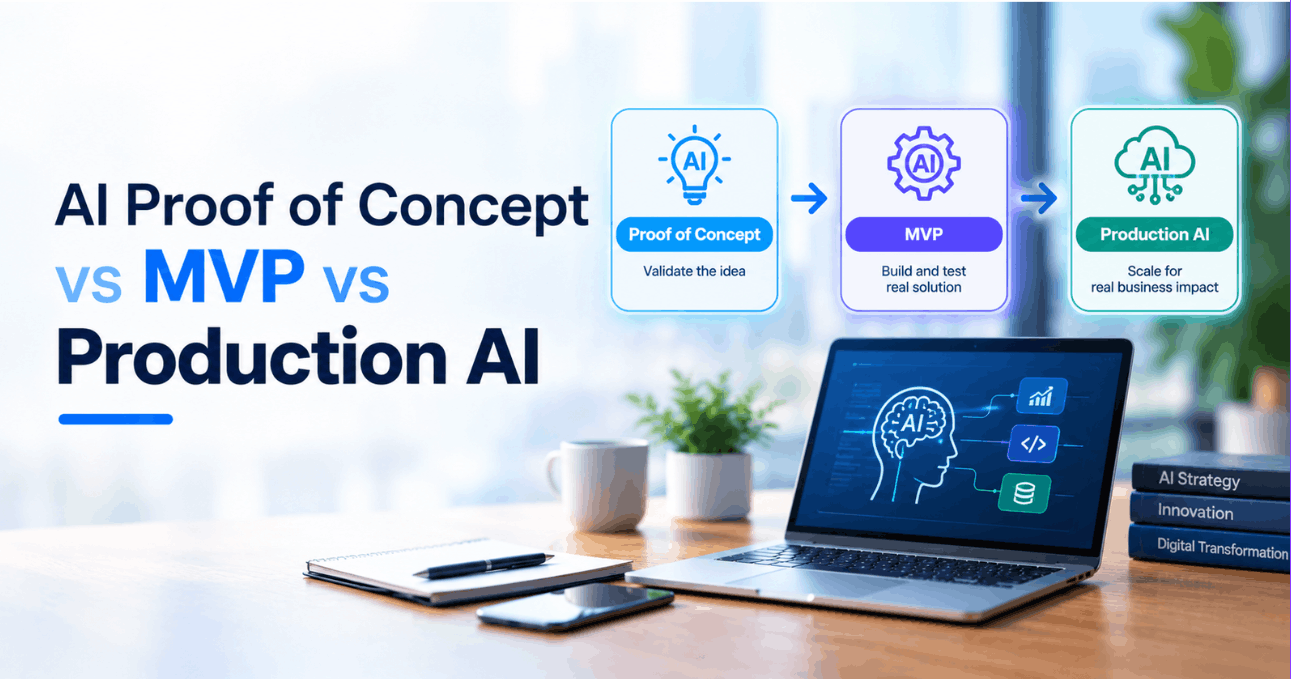
An AI idea can be technically interesting without being ready for users or operations. A proof of concept, a minimum viable product and a production system answer different questions. Treating them as interchangeable makes it harder to set expectations, choose a useful test and know when to invest further.
Start with the decision you need to make
Before selecting a delivery stage, write down the decision the work should inform. Is the uncertainty about data quality, whether a model can perform a task, whether a workflow helps users, or whether an AI feature can be operated safely? Scope the work around that uncertainty rather than around a model demonstration.
- Feasibility: can a defined approach produce acceptable results on representative inputs?
- Product: can intended users complete a real task with the feature and its surrounding workflow?
- Operations: can the organization secure, monitor, support and improve the system over time?
What an AI proof of concept should establish
A proof of concept is a bounded experiment. State its input, expected output, evaluation method, data assumptions and stop conditions. Use representative test cases and a simple baseline where possible. Review errors as well as successful examples; averages can hide failure on an important group of cases.
A PoC is not evidence that a feature is production-ready. It may omit user access, audit history, service reliability, privacy controls, integration, support procedures and ongoing evaluation. Record these gaps as follow-up work instead of implying that a demo already covers them.
When an MVP is the right next step
An MVP tests a small but complete user-facing workflow. Keep the feature set narrow, but include what a controlled pilot needs: clear user feedback, permissions, exception handling and a way to report an incorrect result. Measure task quality and user effort against criteria agreed before the pilot.
For example, a document assistant might return suggested answers with citations for an employee to verify. The pilot can test whether the answers are useful and whether users can identify missing or incorrect evidence before broader automation is considered.
Production AI adds operational responsibilities
Production readiness is not simply a larger model or more traffic. It includes versioned prompts and models, access controls, data-retention decisions, monitoring, incident ownership, fallback behavior, cost and latency limits, and a repeatable evaluation process. The exact controls depend on the use case and its risk.
A practical stage-gate checklist
- Define the user problem and the decision the next stage must support.
- Document data access, quality, consent and retention assumptions.
- Choose representative evaluation cases and an acceptable error policy.
- Run a bounded PoC; record both results and limitations.
- Use an MVP only when a supervised user workflow is ready to test.
- Plan production controls and ownership before exposing the feature broadly.
There is no mandatory sequence: a low-risk, well-understood task may not need a separate PoC, while an uncertain or consequential use case may need more validation before a user pilot. Choose the smallest stage that answers the next important question.
Related reading
For help scoping an AI feasibility assessment, see UfaqTech AI development services or contact the team.


Post Comments